Outboard engines and spare parts
How much engine you need inland and what the rules allow, checking a used outboard, servicing and laying up, and where to find fuel, parts and repairs.
Updated 23 Oct 2026
On this page
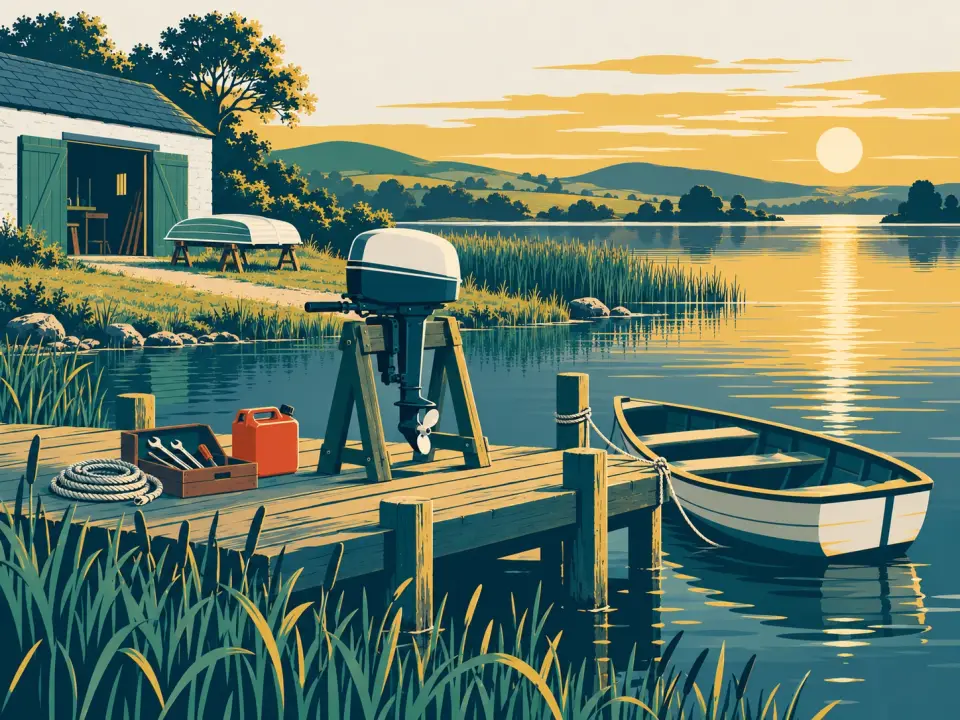
Most trouble on the water starts in the engine bay: a blocked filter, a tired impeller, a flat battery. The good news is that a well-kept engine on Ireland's calm inland waters can run for decades. This page covers choosing an outboard, keeping one running, and finding fuel and parts along the way.
Good to know: This is general guidance, not a workshop manual. Follow your engine's own manual, and leave gas, fuel and electrical work beyond the routine to a qualified marine engineer.
How much engine do you need?
Less than on the sea. Speed limits keep boats slow on most inland water: 5 km/h near bridges, jetties, locks, harbours and moored boats on Waterways Ireland's navigations (Special Marine Notice 1/2026), 3.2 knots on the Grand and Royal Canals (Waterways Ireland), and 5 knots on the Erne (Waterways Ireland). What you do need is enough power to push against a strong headwind on an open lake or the current of a river in flood, and to stop.
Some rules depend on engine size:
- Registration. An open, undecked boat with an engine of 15 horsepower or less needs no Waterways Ireland registration on the Shannon; on the Erne the limit is 10 horsepower. Every other boat is registered, free (Waterways Ireland).
- Young drivers. Nobody under 12 may drive a boat with an engine over 5 hp, and nobody under 16 a jet ski or fast power boat (S.I. 921/2005).
- The boat's own limit. The builder states the maximum engine power the boat is designed for in its owner's manual (Directive 2013/53/EU, Annex I). A bigger engine makes the boat harder to handle, and your insurer may refuse cover.
Match the shaft length to the transom height (short, long or extra long), and choose tiller steering for a small open boat or remote controls for a boat with a console.
Petrol, diesel or electric
- Petrol outboards power most small boats, RIBs and tenders. New outboards sold in the EU must meet the Recreational Craft Directive's exhaust and noise limits and must not start in gear (Annex I). A second-hand two-stroke is light and simple, but it needs oil in the fuel and parts can be harder to find.
- Diesel inboards drive most cruisers and narrowboats. Fill up where you can: some stretches have no fuel point at all (below Killaloe, for example, we found none).
- Electric outboards are quiet and clean, and suit canals, small lakes and tenders. Shore-power pillars at public harbours take the Waterways Ireland Smart Card, 1 unit per 2 kWh, and are switched off from November to March (The Smart Card). Plan your range with a margin for wind.
Buying a second-hand outboard
- Check the serial number on the engine's plate against the receipt or the boat's paperwork, and ask where the engine came from.
- Start it from cold. It should start easily and idle smoothly. Ask the seller not to warm it up before you arrive.
- Watch the tell-tale. A steady stream of cooling water from the small outlet means the water pump works. A weak stream often means a worn impeller.
- Drain a little gearbox oil. Milky oil means water has got in through a seal.
- Look at the propeller for chips and bends, the leg for corrosion, and the anodes.
- Run it under load, on the boat or in a test tank, through every gear.
- Ask for the service history and the hours on engines that record them.
Once it is yours, note the serial number, take photos, and fit an outboard lock.
A season of servicing
Follow the service schedule in the manual. A typical annual service before the season covers:
- the water-pump impeller (often every one or two seasons),
- gearbox oil, engine oil and oil filter on four-strokes,
- spark plugs or, on a diesel, the fuel filters and the water separator,
- the anodes, the propeller and its shear pin or bush,
- grease points, throttle and gear cables, and the fuel lines and primer bulb.
On board, carry a spare impeller, a fuel filter, plugs, a shear pin or split pin for a small outboard, a spare kill cord, basic tools and a torch. Keep fuel in a proper fuel can, refuel with the engine off and nobody smoking, and keep an extinguisher within reach (Safety on board).
Moving between waters? Zebra mussels and weed fragments hide in cooling-water intakes and on the leg: check, clean and dry the engine as well as the boat (invasives.ie).
Laying up for winter
Inland winters are mild, but frost still cracks engine blocks and fuel goes stale. Before the boat goes into its winter berth:
- run the engine warm and change the oil while it is dirty, so old oil does not sit in it all winter;
- add a fuel stabiliser to the tank, or run small carburettor outboards dry, as the manual says;
- drain the raw-water cooling system or fill it with antifreeze on an inboard, and store an outboard upright and frost-free;
- take the batteries home or keep them charged: power at public moorings is off over the winter (Marine Notice 107/2026);
- book the spring service now rather than in March, when the yards get busy.
Fuel, parts and repairs along the waterways
- Fuel: our map shows the boat fuel points we list, separately from road filling stations.
- Boatyards and slipways: the map's OpenStreetMap layer shows boatyards and slipways; at a private marina, ask before you use its slipway.
- Chandleries and marinas: the map shows the chandleries we list so far; marinas are often the best place to ask for a local mechanic.
- Engines and parts for sale: outboards, controls and fittings from boaters and dealers, listed on buz.ie, our own marketplace (run by the same team as Jetty Hop): see boats, engines and parts for sale.
If the engine fails under way, drop the anchor or tie up before you start working on it, and on a lake call for help early rather than late: 112 or 999, and ask for the Coast Guard.
In an emergency
Call 112 or 999 and ask for the Coast Guard. Both numbers work in Ireland and in Northern Ireland.
Safety on the waterIn an emergency
Call 112 or 999 and ask for the Coast Guard. Both numbers work in Ireland and in Northern Ireland.
Safety on the water