Safety on board
Emergency numbers, lifejacket law, the hazards that catch boaters out on Irish lakes, rivers and canals, and the rescue services on the waterways.
Updated 23 Oct 2026
On this page
Ireland's inland waterways are gentle most of the time, and most accidents happen in calm water close to the boat: a slip on a wet deck, a fall between the boat and the jetty, a jump ashore that goes wrong. A few habits prevent nearly all of them.
In an emergency
Emergency: Call 112 or 999 and ask for the Coast Guard. Both numbers work in Ireland and in Northern Ireland (Waterways Ireland, Water Safety Ireland). If you have a VHF radio, call on channel 16. Say:
- what has happened and how many people are involved,
- where you are: the nearest town, harbour, lock or mark number, or the coordinates from your phone,
- what boat you are on (type, colour, name).
RNLI lifeboats are stationed on the inland waterways at Lough Derg (Dromineer), Lough Ree (Coosan Point, Athlone), Carrybridge (Upper Lough Erne) and Enniskillen (Lower Lough Erne) (RNLI stations); the Coast Guard calls them out. For a breakdown that is not an emergency, call your hire base or, on the Shannon–Erne Waterway and the canals, the Waterways Ireland patrollers whose numbers are on each navigation's boater information page.
Lifejackets: the law and the habit
Under S.I. 921/2005, the Republic's pleasure-craft safety regulations:
- every boat must carry a suitable lifejacket for each person on board;
- on a boat under 7 metres, everyone must wear one when in an open boat or on deck, unless the boat is tied up or at anchor;
- on any boat, the skipper must make sure children under 16 wear one in an open boat or on deck, unless the boat is tied up or at anchor;
- anyone being towed (a tender, a ringo) must wear one;
- nobody under 12 may drive a boat with an engine over 5 hp, and nobody under 16 a jet ski or fast power boat.
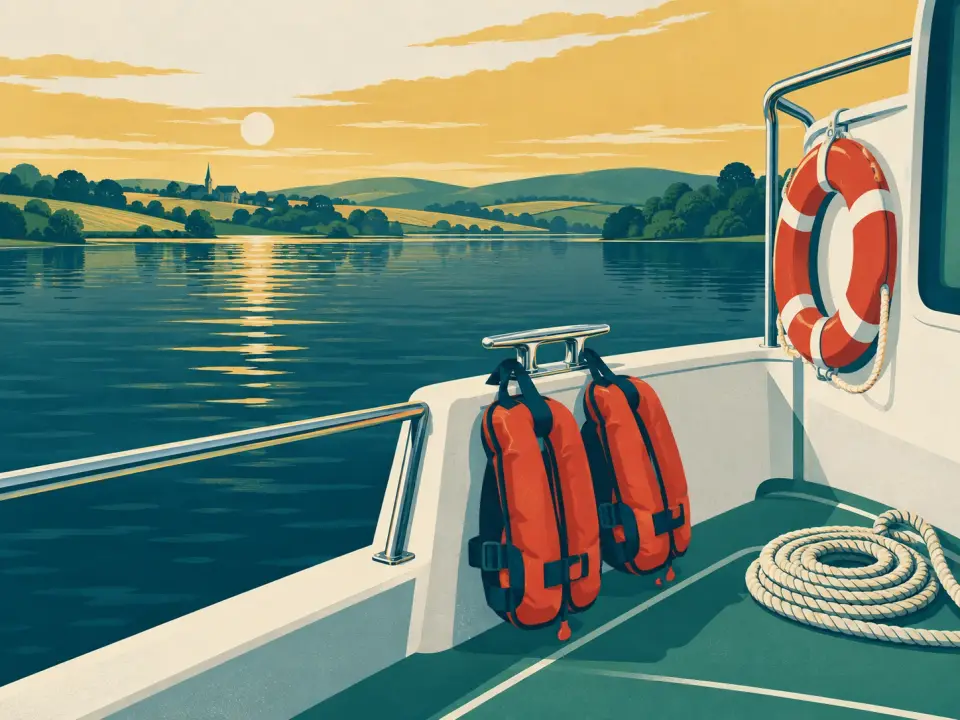
On top of that, Waterways Ireland requires everyone working on deck to wear a lifejacket in every lock on its waterways (Special Marine Notice 1/2026). Our advice: wear one whenever you are on deck while the boat moves, when mooring, and on jetties at night. Northern Ireland has its own rules; on the Erne the same habit is the safe one.
Hire boats come with lifejackets. Check that each fits and is fastened, including the crotch strap for children. An inflatable jacket needs its gas bottle and trigger in good order (Water Safety Ireland).
The hazards that catch people out
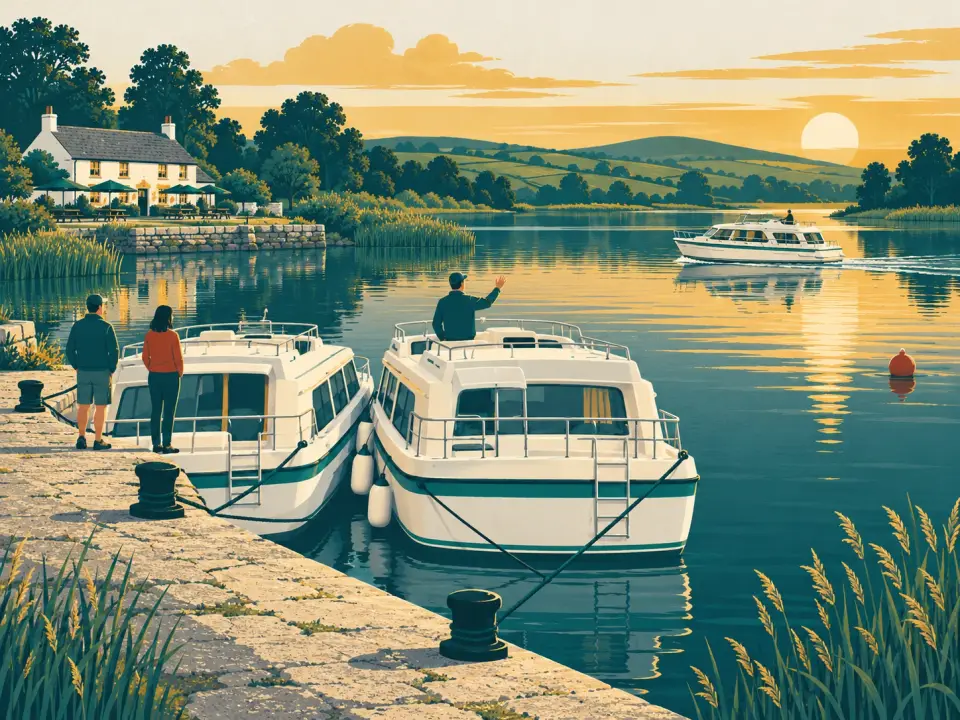
- Between the boat and the jetty. Never jump, never put a hand or foot between boat and wall, and never try to stop a moving boat with your body. Use a boat hook or let it touch and try again.
- Cold water. Irish lakes are cold even in summer. Falling in can cause gasping, panic and loss of strength within two or three minutes (Water Safety Ireland). Lifejackets give you the time to be rescued.
- Weirs and sluices. The water above a weir looks calm and pulls hard. Keep well clear, follow the signs to the lock, and never swim near one.
- Night and alcohol. A fall into the water after dark, on the way back from the pub, is the classic avoidable accident. Take a torch, walk the jetty with care, and remember that operating a boat under the influence is an offence (Maritime Safety Act 2005, s. 28).
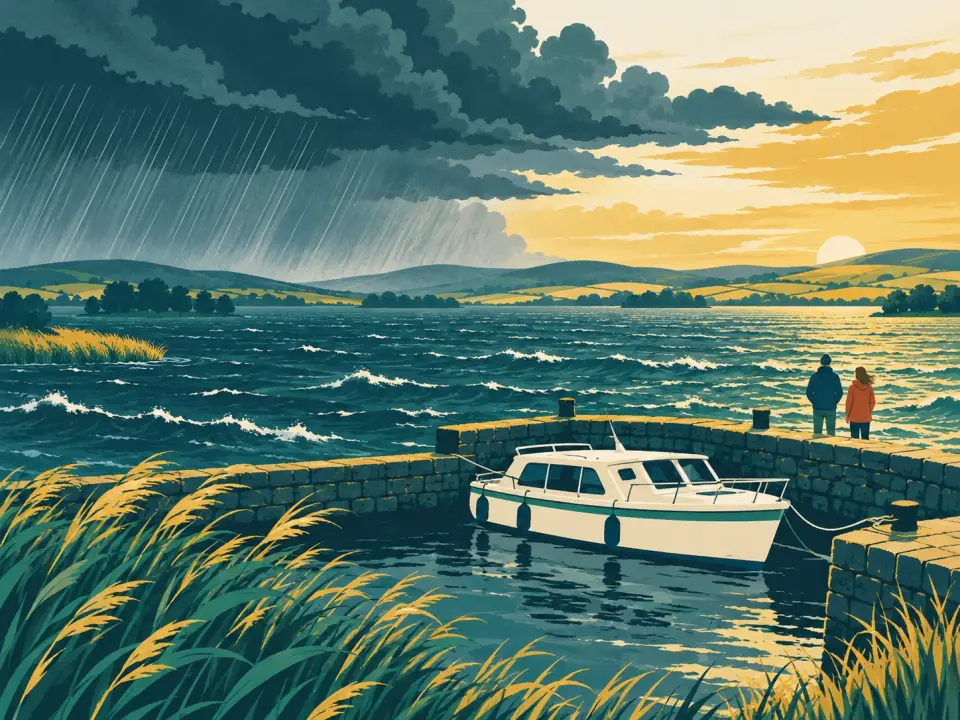
- Big lakes in wind. See Weather.
- Propellers. Stop the engine before anyone goes into the water near the boat, and before picking someone up.
- Overhead power lines. Sailing boats and anyone carrying a mast must check the clearance; on the Shannon lines are kept at least 12.6 m above normal summer level. If a boat touches one, do not move it, keep everyone well clear and call 112 or 999 (Special Marine Notice 1/2026).
Fire and gas
Boats carry gas for cooking and diesel for the engine. Know where the extinguisher and fire blanket are, turn the gas off at the bottle when you are not cooking, keep a window open while the cooker runs, and never use a charcoal barbecue on board or under a canopy. Fit and test a carbon monoxide alarm on your own boat. Waterways Ireland and the fire services publish a fire safety checklist for boats. Waterways Ireland asks moored boats to keep about a metre apart for fire safety and rescue.
Man overboard
- Shout "man overboard", point at the person and keep pointing.
- Throw a lifebuoy or anything that floats.
- Put the engine in neutral at once, so the propeller stops turning.
- Come back slowly into the wind or current and stop alongside with the engine in neutral; lift them in at the lowest point of the boat or on the swim ladder.
- If you cannot reach them quickly, call 112 or 999.
Practise this once at the start of the trip with a fender: everyone will remember it.
Tell someone your plan
Before a lake crossing or a longer trip, let someone ashore know your route and when you expect to arrive (Water Safety Ireland). Keep a charged phone in a waterproof pouch and note the hire base's number. Check the current marine notices for closures before you set off.
Good to know: This is a travel guide, not a navigation aid, and no substitute for the official safety guidance of Water Safety Ireland, the RNLI and your hire company.