Your first trip on the water
What a first boating holiday on Ireland's lakes, rivers and canals is really like, from the handover to the last morning, and the few rules that matter.
Updated 23 Oct 2026
On this page
Most people who cruise the Shannon or the Erne for the first time have never steered a boat before. That is normal, and it is allowed: you do not need a boat licence to hire a cruiser in Ireland. Every hire company we checked says so and gives you a briefing and a short training run before you leave the base (Emerald Star, Carrickcraft, Silverline). After an hour or two at the wheel most crews relax. This page covers what first-timers ask most.
Good to know: This is a travel guide, not a navigation aid. Steer by the official chart, the marks on the water, the current marine notices and your hire company's briefing.
Before you go
- Read the boat's rules early. Hire contracts differ on where you may go, pets, fuel and deposits. All the ones we read forbid cruising after dark, so a day on the water ends before sunset. See Hire a boat.
- Crossing into Northern Ireland? The Erne is in the UK. Most visitors who are not Irish or British need a UK Electronic Travel Authorisation (ETA), even though nobody checks at the land border (GOV.UK). Prices there are in pounds.
- Pack for four seasons. Waterproofs, warm layers, non-slip shoes, a torch and sunglasses. The weather changes quickly on the lakes.
- Save the region for offline use in this guide before you leave home: mobile signal is patchy on some stretches.
Arrival day
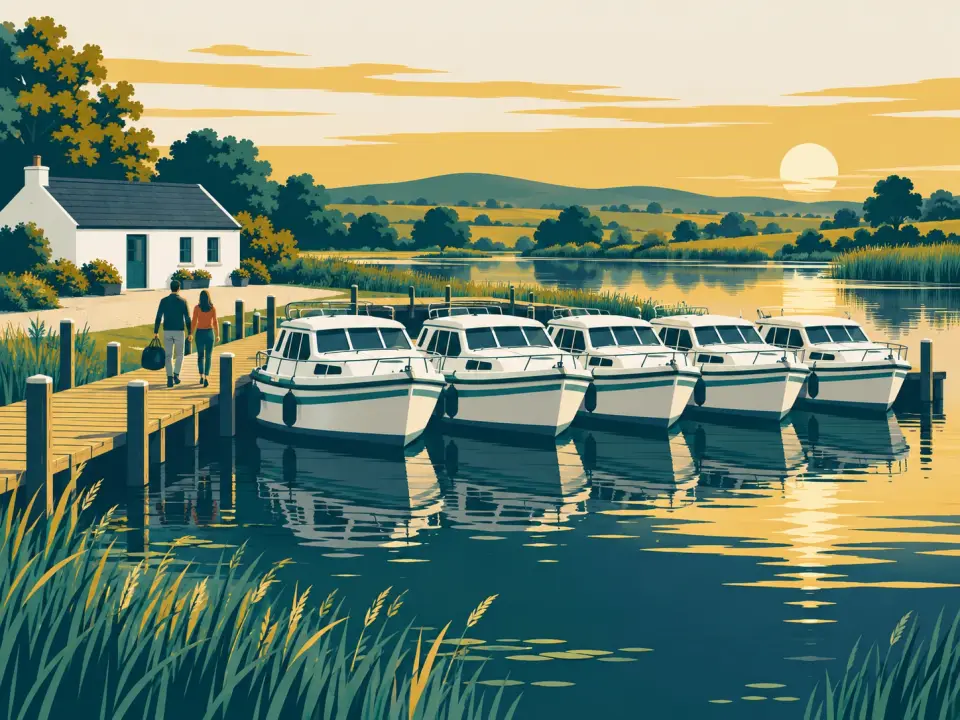
Hire bases usually hand boats over in the afternoon (often from about 4 pm) and want them back by about 10 am on the last day; check your booking. Expect a walk-through of the engine, toilet, gas, water and heating, a look at the charts, then a demonstration cruise where you steer and moor yourself. Ask every question you have: how to read the fuel and water gauges, which areas are off limits, and what to do if something breaks. Most crews do a big shop near the base and spend the first night close by.
A typical day
Plan on three to six hours under way, not more. Hire cruisers are slow, and the best part of the trip happens ashore: a walk, lunch at a waterside pub, a swim, a castle. Leave by mid-morning, aim to tie up by late afternoon, and keep a second mooring in mind in case the first one is full.
Things that shape the day:
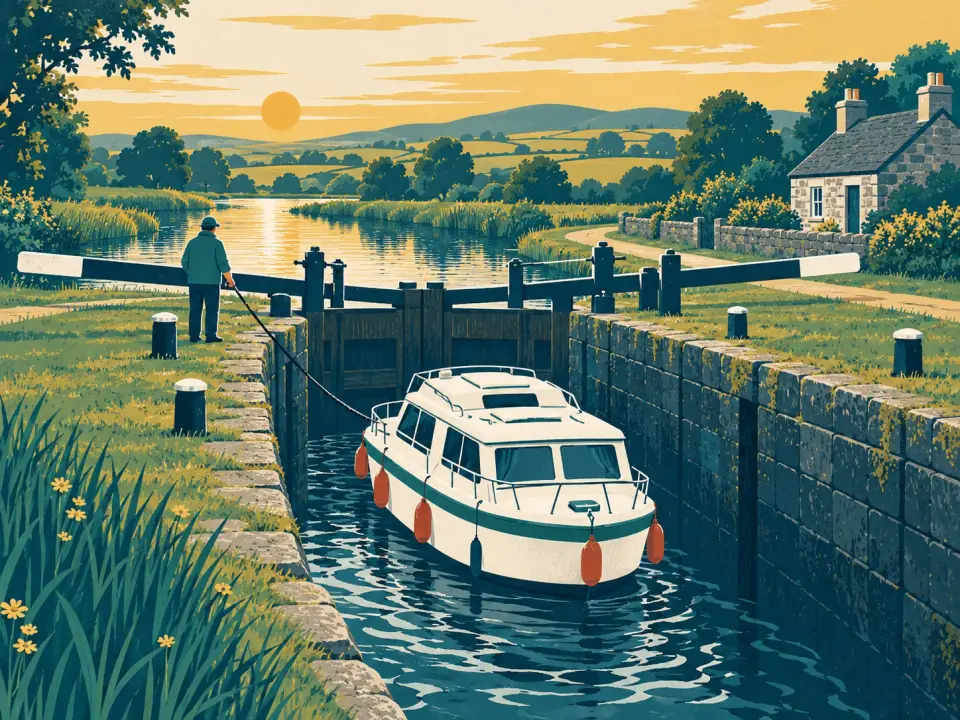
- Locks have opening hours. Shannon lock-keepers work set hours with a lunch break from 13:00 to 14:00 (Waterways Ireland). See Locks.
- Portumna Bridge opens only at set times. Plan to arrive a little early. See the lock and bridge times.
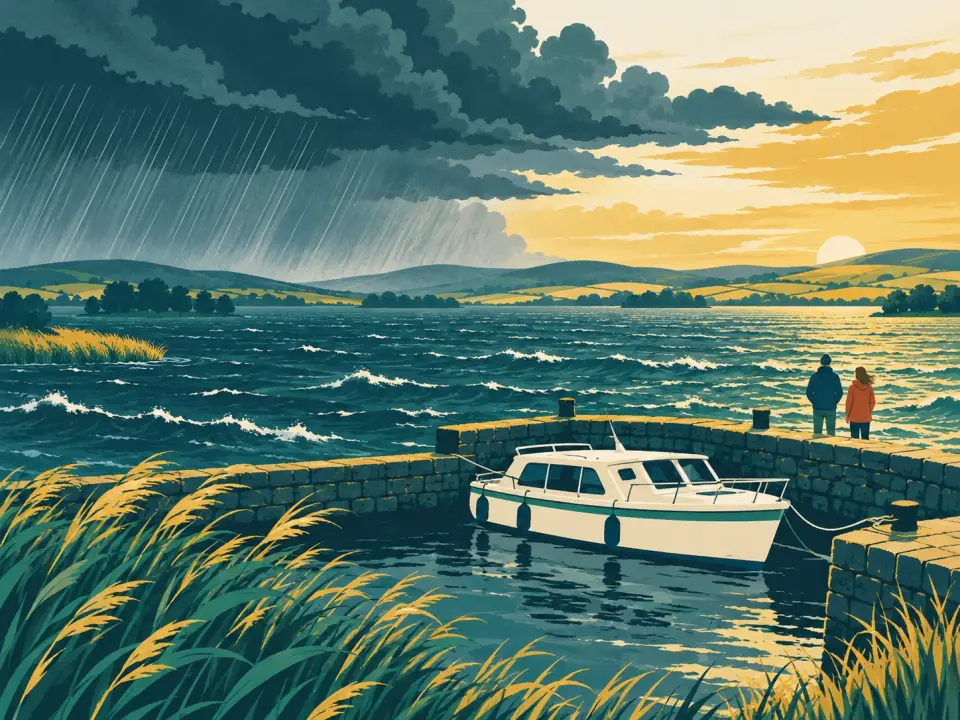
- The big lakes can get rough. Lough Derg, Lough Ree and Lower Lough Erne deserve a look at the forecast before you cross. See Weather.
- Mooring time limits apply. On the Shannon you may stay at the same public harbour for at most five days in a row, all year round. See Mooring.
The rules that matter most
- Keep to the marked channel. Marks show you where the deep water is; cutting corners is how boats run aground. See Navigation marks.
- Slow down near other boats, jetties, bridges and locks. On the Shannon the bye-laws set 5 km/h within 200 m of a bridge or jetty, in harbours and within 100 m of a moored boat (Shannon Navigation Bye-laws 1992, restated in Special Marine Notice 1/2026). Your wash rocks moored boats and erodes banks.
- Everyone has a lifejacket, children wear theirs. Irish law requires one on board for every person and makes under-16s wear one on deck. Waterways Ireland also requires everyone handling ropes on deck to wear one in every lock. See Safety.
- No drinking at the wheel. Operating a boat while under the influence is an offence in Irish waters (Maritime Safety Act 2005, s. 28).
- Be moored before dark. It is a hire-contract rule, and it is common sense: marks and shallows are hard to see at night.
Water, power and the Smart Card
Your boat has a fresh-water tank, batteries charged by the engine, and a holding tank for the toilet. Fill water where the harbour has a tap, empty the holding tank at a pump-out, and run the engine every day so the batteries stay charged. Showers, pump-outs and shore power at public harbours on the Shannon and the Shannon–Erne run on a prepaid Smart Card. Electricity and water at public moorings are switched off from November to March (Marine Notice 107/2026).
If something goes wrong
Emergency: In an emergency on the water call 112 or 999 and ask for the Coast Guard (both numbers work in Ireland and Northern Ireland). For a breakdown, call your hire base first: their number is in the boat's folder. Note the nearest place name or mark number before you call. Nothing is ever so urgent that you need to jump between a boat and a wall.
On the last day
Hire companies charge for the fuel you used: some by engine hours, some by refilling the tank at the end. Leave time to pump out, tidy up and hand over by the agreed hour. Then take the slow way home: most crews already know where they want to go next time.
In an emergency
Call 112 or 999 and ask for the Coast Guard. Both numbers work in Ireland and in Northern Ireland.
Safety on the waterIn an emergency
Call 112 or 999 and ask for the Coast Guard. Both numbers work in Ireland and in Northern Ireland.
Safety on the water