Mooring
Where you may tie up, for how long on each waterway, what public, private and club moorings mean, and how to come alongside without drama.
Updated 23 Oct 2026
On this page
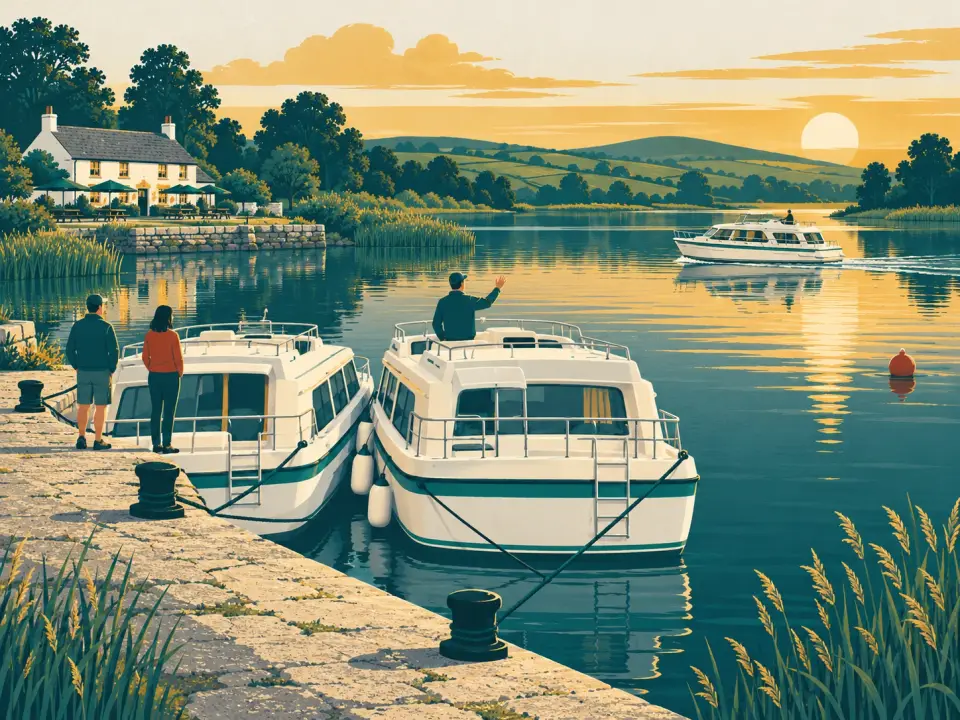
Finding a good mooring for the night is the rhythm of every trip: a jetty by a pub, a quiet harbour wall, a pontoon under a castle. Here is how mooring works on Ireland's inland waterways, and how to read the access badges on our map.
Good to know: This is a travel guide, not a navigation aid. Depths and conditions at a jetty change with the water level; look before you come in.
Who may moor where
Our map marks every mooring we know with who may use it:
- Public harbours, jetties and quay walls, mostly run by Waterways Ireland or a county council. First come, first served, within the time limits below.
- Visitors welcome / by arrangement: private marinas that take visiting boats. Call or book ahead; there is usually a fee.
- Customers only: a pub or hotel jetty for people eating or staying there.
- Members only: a club mooring. Ask the club before you tie up.
- Hire fleet only: a hire base's own pontoons. Not a visitor berth, though some sell fuel or offer a pump-out.
- Not yet checked: we have not confirmed access yet. Treat it as private until you know otherwise.
- Private · not yet checked: a private marina whose rules for visiting boats we have not confirmed yet. Call before you plan a night there.
- No visitors: a private mooring that does not take visiting boats.
The badge never depends on whether a business pays us.
What is a private marina?
A private marina belongs to a business, a hotel, a club or a hire company, not to Waterways Ireland or a council. Its owner sets the rules and the price. Many take visiting boats for a fee, sometimes with power and water; some only when a berth happens to be free; some not at all. Call or book ahead, ask about the price and the depth, and never take an empty berth without asking: it may belong to a boat that is out for the day. Hire-fleet pontoons are part of the hire base, not visitor berths. When our map says Private · not yet checked, we know who runs the marina but not yet whether it takes visitors.
How long you may stay
| Waterway | Rule |
|---|---|
| Shannon and Shannon–Erne Waterway | At the same public harbour for at most 5 days in a row, or 7 days in total in any month, all year round |
| Erne | 48 hours at a public mooring, then at least 4 hours away before you come back |
| Grand Canal, Royal Canal, Barrow | Boats need a canal permit; it allows up to 5 days at one public mooring |
| Lower Bann | No time limits |
The Shannon rule applies all year. Bye-law 17(3) of the Shannon Navigation Bye-laws 1992 sets the 5-day and 7-day limits without any season. Some Waterways Ireland pages mention only April to October, but its own FAQ says the rule applies all year round unless you have a winter mooring (FAQ), and Marine Notice 107/2026 confirms that the 5-day rule stays in force over the winter for boats without one. Public harbours are for short visits, not for living aboard (Special Marine Notice 1/2026).
The Erne limit comes from the Erne boater information; for a longer stay, contact the Lough Erne Warden or find a private berth.
Canal permits
Every boat on the Grand Canal, Royal Canal and Barrow must display a permit. The Combined Mooring and Passage Permit costs €126 a year and covers locks and up to five days at one place in a calendar month; a longer stay at one spot needs an Extended Mooring Permit (€278, including the passage permit). A free visitor permit lets a boat from elsewhere stay up to 31 days, once a year (FAQ, permits). On a hire boat the company looks after the permit.
Winter mooring
From 1 November to 31 March you can book a winter mooring at public harbours on the Shannon and the Shannon–Erne Waterway. In 2026–27 it costs €63.50, paid online by 1 November. Electricity and water at public moorings are switched off from November to March, and you may be asked to make room for visiting boats (Marine Notice 107/2026, winter mooring). There is no winter mooring scheme on the Erne or the Lower Bann.
Coming alongside
- Look first. Pass the jetty slowly and check the space, the depth markings, other boats and the wind.
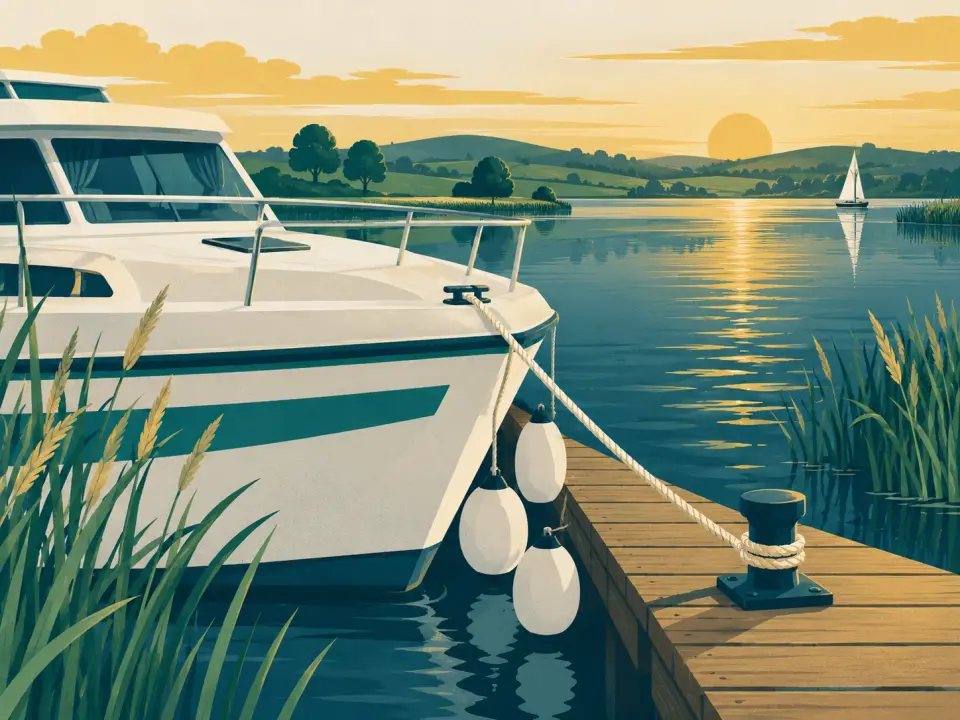
- Fenders out on the side you will moor, at the height of the jetty edge. Lines ready, coiled, one end made fast on board.
- Come in slowly, into the wind or the current if you can: it acts as a brake. On a river, turn and moor facing upstream.
- Step, don't jump. One crew member steps off at the middle of the boat when it is close and stopped, and takes a line straight to a cleat or bollard.
- Bow line, stern line, then springs if you are staying. Leave a little slack for the water level to move.
- Turn off the engine and switch on the kettle.
Harbour manners
Use only the bollards and cleats provided, leave ladders, slipways and pump-outs clear, and keep about a metre between your boat and the next for fire safety and rescue. Lead-in jetties at locks are for waiting, not for the night. Don't leave an anchor overhanging the jetty, keep dogs under control, and keep off berths kept for passenger boats when one is due (Special Marine Notice 1/2026). Stern-on mooring is not allowed at Carrybridge.
When a harbour is full, ask a moored crew whether you may come alongside them: see rafting up.
Before you settle in
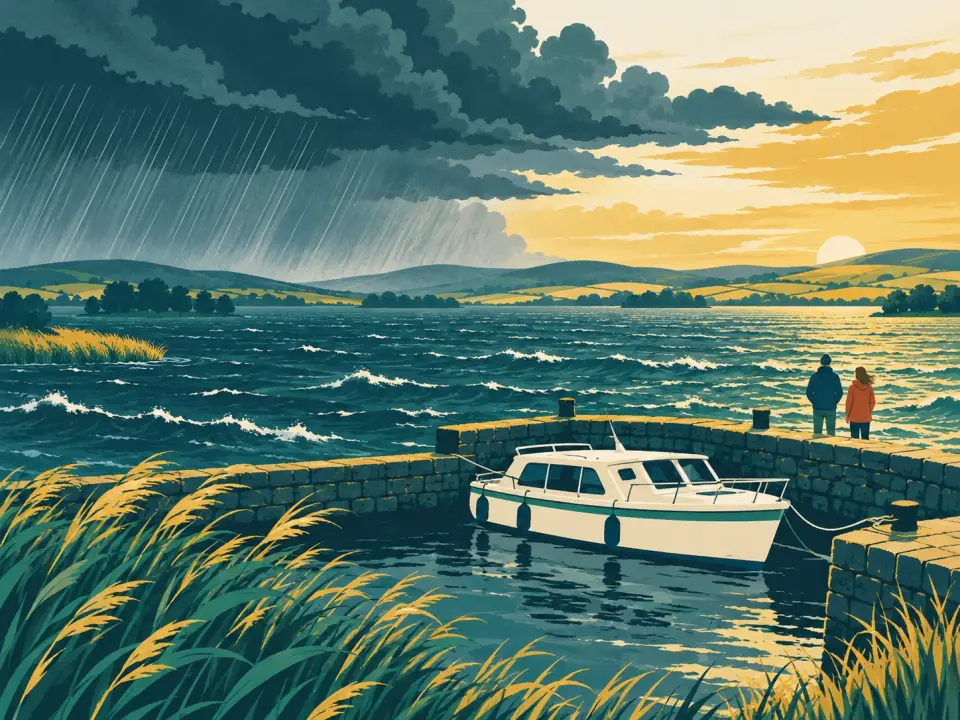
Is there water, power, a pump-out? The quick facts on each place page say what we know and what is still to be checked. Remember that the services at public moorings close from November to March, and that a jetty that is fine in summer can be awash after heavy rain. In a gale, choose a harbour with shelter from the wind direction in the forecast; see Weather.
In an emergency
Call 112 or 999 and ask for the Coast Guard. Both numbers work in Ireland and in Northern Ireland.
Safety on the waterIn an emergency
Call 112 or 999 and ask for the Coast Guard. Both numbers work in Ireland and in Northern Ireland.
Safety on the water